

The Money That Looked Guilty
Case #1: When suspicion needed no proof, the law only had to take the money.

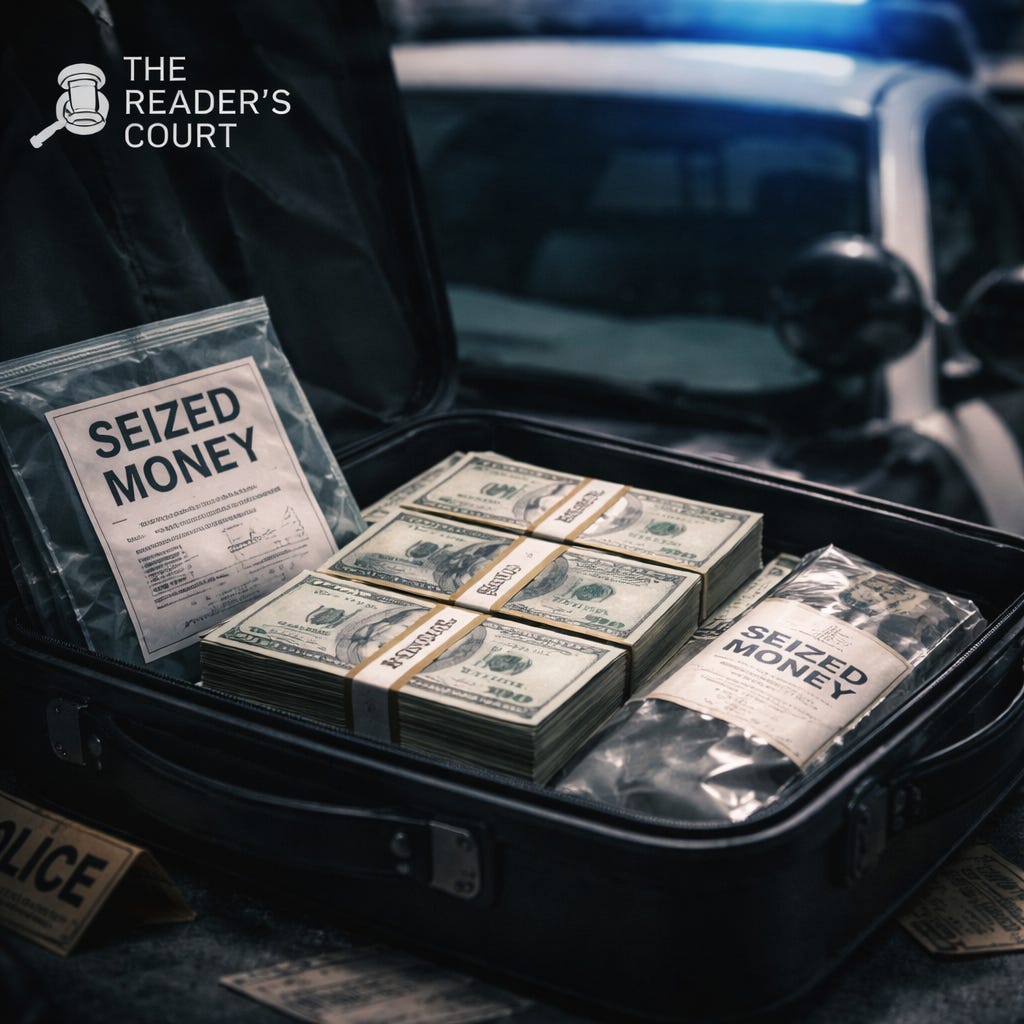
Exhibit A
Trooper Nathan Calder had decided to stop the sedan before it passed him.
It was not speeding. The gray Nissan moved along Interstate 40 at exactly seventy-five, the late afternoon sun pressing the desert flat into bands of copper, dust, and heat shimmer. The driver held the right lane with such disciplined steadiness that it felt less like driving than obedience.
That was what caught Calder’s eye.
Most people changed when they saw a patrol car. They touched the brake too quickly. Drifted. Checked their mirrors too often. Tried to look casual and failed.
This man did none of that.
He held the wheel at ten and two as if someone had taught him how innocence should look.
Calder pulled onto the interstate and let the sedan pass. Illinois plates. Rental sticker on the windshield. Clean car. Anonymous. The kind that belonged nowhere and moved through everything.
He settled in behind it.
Three miles. No lane drift. No creeping over the limit. No sudden correction. Just a man in a rental, driving as if attention itself were dangerous.
Calder hit the lights.
The sedan moved onto the shoulder at once, gravel ticking under the tires. Before Calder reached the window, it was already lowering.
“Good afternoon, officer.”
The driver looked mid-forties. Thin face. Tired eyes. A paperback sat on the passenger seat with a boarding pass tucked inside. Two suit jackets hung from the rear handle under dry-cleaning plastic.
“Do you know why I stopped you?” Calder asked.
“No, sir.”
“Your lane discipline was unusual.”
The man blinked once, thoughtful rather than rattled.
“I was trying to be careful.”
“License and registration.”
The man handed them over immediately.
Daniel Whitaker.
The rental agreement matched. Calder let his gaze move across the interior again. Thermos in the cup holder. Two suitcases in the back. Laptop bag on the floor. No clutter. No visible mess. Nothing spontaneous. The car looked like a life already packed down.
“Where are you headed, Mr. Whitaker?”
“Santa Fe.”
“Purpose of travel?”
“Personal.”
Calder let the silence sit.
Most people tried to fill silence. Whitaker didn’t.
“What line of work are you in?”
“I used to teach.”
Used to.
“Mind if I take a look inside the vehicle?”
Whitaker glanced toward the highway, trucks rushing past in hot gusts, then back at Calder.
“Is that a request or a requirement?”
“Just a request.”
A beat.
“Alright.”
Whitaker stepped out carefully, not fearfully, but like a man who had lately become familiar with breakage. He stood near the rear quarter panel while Calder searched.
The first suitcase held folded shirts, socks, underwear, a toiletry bag packed with the neatness of someone who no longer owned enough to be careless. The second held slacks, a navy blazer, and a framed photograph wrapped in one of the shirts.
Calder unwrapped it.
Whitaker stood beside a woman in front of a modest white house with a SOLD sign in the yard. She wore a scarf over her hair. Both of them smiled with the effort people use when they are trying to make a hard thing look chosen.
Calder set the frame aside.
The laptop bag held exactly what it ought to hold. Computer. Charger. Legal pad. Bank envelope.
Then, under the spare-tire panel, he found another envelope taped beneath the compartment.
He peeled it free and opened it.
Cash.
A thick stack of it.
He counted once. Then again.
Forty-two thousand dollars.
When he looked up, Whitaker was watching the envelope, not Calder.
“That’s a significant amount of currency,” Calder said.
Whitaker nodded. “Yes.”
“Why are you traveling with that much cash?”
Whitaker kept his eyes on the envelope. A semi blasted past, shaking the sedan.
“I sold my house.”
“Why not wire it?”
A faint smile passed over Whitaker’s mouth and died there.
“Because the bank froze our account three times during my wife’s treatment over fraud alerts.” He swallowed. “I spent a year asking permission to pay for things while she was dying. I decided not to do that again.”
Calder said nothing.
Whitaker looked toward the photograph on the trunk.
“She picked Santa Fe,” he said. “She said if things got bad enough, we should at least fail somewhere with light.”
There were no drugs in the car. No weapons. No warrants. Nothing except neat luggage, a dead woman in a photograph, and too much cash.
But cash had a way of becoming guilt before anything else did.
“When did she die?” Calder asked.
“Eleven weeks ago.”
The answer came too fast to have been estimated.
Calder took an evidence bag from the cruiser. The plastic crackled in the heat.
Whitaker stared at it. “What are you doing?”
“This money is being seized under civil forfeiture.”
Whitaker looked at him as if the words had arrived in the wrong language.
“You’re taking it.”
“It’s suspected to be connected to criminal activity.”
“You just searched the car.”
Calder said nothing.
“You found clothes.”
Silence.
“You found my wife.”
Whitaker nodded toward the photograph.
“You found the rest of my life in two suitcases and a paperback.”
Calder slid the envelope into the evidence bag and sealed it.
Whitaker took one step forward. Not threatening. Just human.
“I’m not under arrest?”
“No.”
“So what crime did I commit?”
“That will be determined later.”
The words struck him harder than if Calder had raised his voice.
Traffic kept moving. Pickups. Semis. A livestock truck carrying the sour smell of manure and heat. Nobody slowed. Nobody looked. The desert stretched away on both sides, immense enough to make private suffering seem administrative.
Whitaker rubbed a hand over his face and turned toward the road.
“That money is for the house,” he said quietly.
Calder gave no answer.
Whitaker looked back at him. His eyes were red now with effort.
“It was the first thing that was going to be mine outright in twenty-three years.”
The tow truck arrived in diesel noise and rattling chains. Calder signed the form, then handed Whitaker the receipt for the seized currency.
Whitaker stared at the slip of paper.
Forty-two thousand dollars had become a receipt.
“What happens now?” he asked.
“You can challenge the seizure in court.”
“How long does that take?”
“It depends.”
Whitaker folded the receipt with extraordinary care, as if it were fragile enough to tear under the weight of what it represented. He slipped it into the inside pocket of his jacket.
“And until then?”
Calder closed the trunk.
“Until then, the money stays in custody.”
Whitaker looked at the evidence bag on the hood of the cruiser. Forty-two thousand dollars. A house in Santa Fe. Light. A promise to a dying woman. Flattened into property held pending review.
Calder got back into the patrol car.
In the mirror he watched Whitaker standing beside the rental with one hand on the roof, as though he needed to steady the world nearest him. The tow truck driver was speaking, pointing, asking a practical question about destination. Whitaker did not seem to hear him.
When Calder pulled back onto the interstate, Whitaker was still there in the dust and heat, jacket over one arm, receipt in his pocket, watching the cruiser carry his future west.
The road to Santa Fe had not changed.
It had simply become longer than a man could walk.
The Question
Daniel Whitaker was not arrested.
No drugs were found in his car. No weapon. No warrant. No evidence of violence. No evidence that the money had come from any crime at all.
What the trooper found was cash, grief, and a man driving toward the last future he and his wife had planned together.
So if no crime had been proven, no charge had been filed, and no guilt had been established, what exactly gave the state the right to take his future anyway?
The Autopsy
What happened on that stretch of desert highway was not unusual. Civil asset forfeiture laws allow the state to seize property suspected of involvement in criminal activity even when the owner has not been charged with a crime.
Most citizens assume the law moves against a person. In forfeiture, it often moves against the property itself. A case may be filed not as a prosecution of Daniel Whitaker, but as a proceeding against the asset:
State v. $42,000 in U.S. Currency.
That structure matters because it shifts the burden. The state does not need to prove, at the moment of seizure, that Whitaker committed a crime. It only needs to assert that the money may be connected to unlawful activity. Once the property is taken, the owner must begin the process of getting it back.
In criminal law, the burden is supposed to remain with the state. Guilt must be proven before punishment follows. In forfeiture, that sequence is weakened. Property can be removed first. The fight over legitimacy comes later, and the owner must finance that fight himself.
That process is not neutral. It requires time, legal knowledge, filing deadlines, and money. For many people, contesting a seizure costs enough to make surrender rational. The system does not forbid resistance. It prices it.
The financial structure matters too. In many jurisdictions, forfeited assets or their proceeds can return to law enforcement agencies through budgets, equipment, training, or operational support. That creates an institutional interest in seizure that exists alongside the stated interest in public safety.
No officer has to invent evidence for the conflict to exist. No official has to be secretly dishonest. The incentive is already embedded in the design.
That is where the deeper change appears. Integrity, decency, and morality are no longer the first questions asked. The controlling questions become procedural: Was the seizure authorized? Was the paperwork filed? Was the property logged? Was the deadline met?
If those answers satisfy the statute, the system recognizes the action as legitimate even when no criminal conviction exists.
Daniel Whitaker’s grief does not alter that structure.
His intended use for the money does not alter it.
His lack of charges does not prevent it.
The law can still treat the seizure as proper.
The Reader’s Verdict
The traffic stop ended without an arrest.
Daniel Whitaker was allowed to return to the highway and continue west. No charges were filed. No court had yet examined the facts.
Only the money remained behind.
Forty-two thousand dollars now sits in custody, protected more securely than the man it was taken from.
The officer followed procedure.
The department followed statute.
The courts will follow the rules established for cases like this.
Nothing failed.
Everything worked exactly as the system was designed to work.